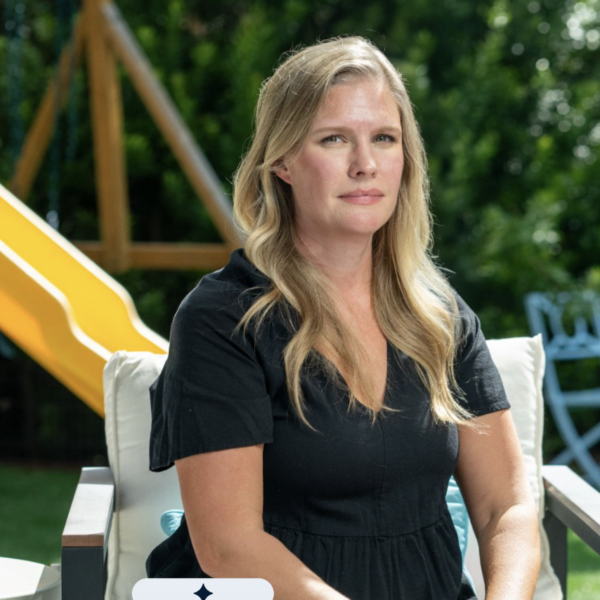
Leitaea Lowrimore went to three ERs in two states in the middle of a medical crisis. No one would treat her.
Synopsis
Leitaea Lowrimore and her husband live in the rural town of Sallisaw, Oklahoma. On a good day, she makes the 45-minute drive to Fort Smith, Arkansas for health care.
When she started experiencing symptoms of an ectopic pregnancy—a life-threatening condition where the pregnancy implants in a location other than the inside of the uterus—she went to the hospital. Bleeding, scared, and in pain, she was turned away from three emergency rooms across Arkansas and Oklahoma. Even as medical professionals acknowledged her pregnancy could not survive, no doctor would treat her because of abortion bans. After six days, Leitaea finally drove to Kansas, where she received the care she needed in a matter of hours.
Leitaea now joins Waldorf v. Arkansas, the first case filed by Amplify Legal, the litigation arm of Abortion in America. The following passage is an excerpt from her lawsuit.
You are sending me home to die.
Leitaea has a full and busy life. She and her husband have a one-year-old daughter together, and the couple shares custody of an 8-year-old and two 10-year-olds from their prior relationships who live with them part-time. Leitaea had another pregnancy years ago when she was suffering from addiction, and made the decision to relinquish the child with the assistance of an adoption agency that allowed her to choose the receiving family. Leitaea found the experience extremely painful and emotional, and it is still difficult for her to talk about.
Leitaea’s periods are usually regular but, in January 2026, she was late. Leitaea had surgery planned at the end of January to address an injury she sustained during the birth of one of her children. As is standard, she was asked to take a pregnancy test before the surgery and the test was negative. But by February 9, Leitaea’s period still hadn’t come, so she took a drugstore pregnancy test. This time, it was positive. As Leitaea would later learn, the medications associated with her surgery may have interfered with her hormonal birth control, causing it to fail.
Leitaea was initially scared and worried. “I already have so many children to care for, including a one-year-old baby, and I was concerned about having two babies back-to-back.” She and her family are on Medicaid and often struggle to make ends meet. Nonetheless, she did not consider terminating the pregnancy.
A few days later, she began to bleed and started to experience sharp abdominal pain on one side of her body. She called her OB/GYN and was told to go to the emergency room.
Editor’s note: At this point, Leitaea visited an emergency room in Fort Smith, Arkansas. After tests administered by the hospital showed irregularities, ER staff could not locate her pregnancy on an ultrasound. Along with her pain and bleeding, these are warning signs of a possible ectopic pregnancy, a condition where the pregnancy is implanted outside of the uterus that can be life-threatening if left untreated. Still, she was sent home twice and told to wait for her symptoms to get worse. At home, searching for answers on her own, Leitaea began to realize just how serious her situation was.
In the days that followed, Leitaea continued bleeding, began to feel dizziness, “seeing stars” whenever she stood up, and the abdominal pain on her left side began radiating up her body. Leitaea recognized that these were all symptoms of ectopic pregnancy. “I just knew that what we were going through wasn’t normal. I was scared. There were a few times I asked my husband if I was going to die. I kept thinking about our kids. I just knew that we weren’t going to stop until we had answers or got the help that we knew we deserved.”
On February 18, Leitaea and her husband got into the car with their one-year-old and drove back to the ER at Baptist. ER staff took yet another blood sample [that indicated her pregnancy was not progressing normally]. An ultrasound once again showed no intrauterine pregnancy but revealed [anomalies],which she was told could be an ectopic pregnancy. ER staff at Baptist, however, again attempted to discharge her with instructions to return when her symptoms were worse, but this time Leitaea protested. She explained her fears that the pregnancy was ectopic and that if she did suddenly deteriorate, she would not be able to get back quickly enough because she lives so far away from emergency health care.
Leitaea requested to speak with the on-call OB/GYN, and the two then had a heated exchange. The OB/GYN acknowledged that, more likely than not, her pregnancy was ectopic. Nonetheless, he said “there is not much that we can do” because “there are no definitive emergent findings on the ultrasound currently.” The OB/GYN then mentioned a potential exploratory surgery to determine if her pregnancy was ectopic but said he could not do the surgery because Medicaid would not cover it. When Leitaea pressed, the OB/GYN said that if he treated her now, he would face “10 years in the poky.” Leitaea was furious: “I felt like my life was a risk he couldn’t afford.” Ultimately, the OB/GYN agreed to admit Leitaea for observation and said that if her pregnancy ruptured while she was at the hospital, he would then be able to intervene. The OB/GYN also said he would contact Mercy to see if they could give her a different answer.
I kept thinking about our kids. I just knew that we weren’t going to stop until we had answers or got the help that we knew we deserved.
By the following morning, February 19, the OB/GYN at Baptist still had not heard back from Mercy. Leitaea was discharged and immediately went to the ER at Mercy.
Leitaea spent the next eight hours waiting to be seen in Mercy’s ER. She went through triage and gave a blood sample, but she did not receive her results. At some point, Leitaea told ER staff that the pain was getting worse, but she was told there were many other people much sicker than she was still waiting to be seen.
Eventually, she lost hope that anyone in Arkansas would help her. Leitaea and her husband—who were still traveling with their one-year-old—decided to get back in the car and drive to Oklahoma City, three hours away. It was only after leaving Mercy’s ER that Leitaea received an email with the results from her blood test: [her results were abnormal and not consistent with a healthy pregnancy]. Leitaea arrived at the ER at the University of Oklahoma late in the day on February 19.
Once again, she received blood testing and an ultrasound. [Her hormone levels had not risen appropriately, and doctors still could not locate the pregnancy on an ultrasound]. Leitaea was seen by an emergency room physician, not an OB/GYN, and explicitly asked for treatment to terminate an ectopic pregnancy. Once again, however, Leitaea was told that she was “not in danger at this point” and they would be discharging her with instructions to get a repeat [blood test] and ultrasound in one week. Leitaea began pleading with the ER physician, convinced the pregnancy was ectopic. She asked for methotrexate first, then for diagnostic laparoscopic surgery, [standard treatment for ectopic pregnancies] both of which the ER physician refused. “You are sending me home to die,” Leitaea told the doctor. The ER physician noted in her medical chart that “[r]egardless of the unsatisfactory feeling that the patient obviously communicated to me, I do think the patient is stable for discharge.” That night, Leitaea and her family stayed with a friend in Oklahoma City.
Editor’s note: After getting legal advice, she came back to the emergency room to demand answers. After even more tests, she asked for treatment, but doctors told her to wait. She was sent home to her friend, still in pain, without the care she believed she needed.
I was ready to give up, but my husband insisted we keep trying, that he couldn’t lose me.
On the morning of Saturday, February 21, Leitaea felt defeated. “I was ready to give up, but my husband insisted we keep trying, that he couldn’t lose me.” Her legal counsel provided Leitaea with the name and address for Wesley Medical Center, a hospital in Wichita, Kansas, and gave Leitaea the cell phone number for the chief OB/GYN: the two spoke on the phone and after the OB/GYN assured Leitaea that a team of physicians would be waiting for her to provide urgent evidence-based care at their facility, Leitaea and her family packed up the car again and drove three hours north to Wichita.
When Leitaea arrived at Wesley Medical Center, the staff was waiting: they immediately checked her in, admitted her, and did another ultrasound and round of blood tests. Within three and a half hours of arrival, the staff had diagnosed Leitaea with an ectopic pregnancy and administered two shots of methotrexate. “I bawled. I felt like a weight had been lifted off my shoulders. They did—in three and a half to four hours—what I’d been searching for for a week.” Leitaea and her husband spent the night in the hospital so she could be observed while her mother-in-law and baby slept in a nearby hotel.
The next day, Leitaea and her family finally returned home to Sallisaw. She has since recovered physically but remains traumatized by the experience. She wants other pregnant people to know “That if they feel something’s wrong when they go in and they don’t get the answer, they deserve to keep fighting because you know your body as a woman better than that doctor standing across from you.”
Leitaea is terrified to be pregnant again because she feels she would need to go all the way back to Kansas again in the event something went wrong.
If this happened to you or someone you love, contact Abortion in America or reach out directly to our team at Amplify Legal.
explore more stories from abortion in america

Hope Ngumezi thought his wife would come home from the hospital after suffering a miscarriage. She never did.

When Miscarriage Is Recast As Murder