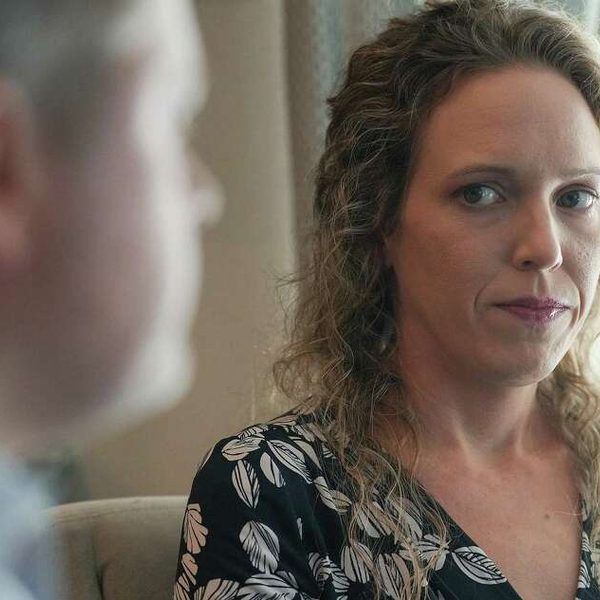
An IVF pregnancy, a medical emergency, and no immediate care under Georgia’s abortion ban
Synopsis
Nicole and Alycia Coles spent years trying to become moms through IVF. When Nicole’s pregnancy took a turn and the couple was informed that their baby would not survive, doctors told them the standard of care to protect Nicole’s life was an abortion but, under Georgia’s abortion ban, they wouldn’t be able to administer care until her life was threatened or the baby’s heart stopped.
Their story is now part of an amicus brief alongside other families living under Georgia’s abortion ban in SisterSong v. State of Georgia, a case challenging the law. Read an excerpt of their brief below.
Nicole and Alycia met through their shared passion for women’s college basketball. Soon, they were inseparable best friends, and, over time, they fell in love and married. After moving to Atlanta for their respective careers, they decided it was also time to start building a team of their own, a family.
As a same-sex couple, they understood the obstacles involved, but they never imagined how difficult it might be or how long it might take. Both were excited to be biological mothers, and together, they decided Nicole would go first because she was a few years older. What followed were four attempts at intrauterine insemination procedures and one in vitro fertilization (“IVF”) transfer. But nothing took.
Finally, after their second embryo transfer, Nicole was pregnant. Because of the earlier challenges, they decided to wait to share their news with friends and family. But when Nicole reached her second trimester and regular check-ups continued to show the pregnancy was progressing normally, they started telling their loved ones. At sixteen weeks gestation, doctors confirmed “the baby had a strong heartbeat and everything looked awesome,” said Nicole.
But just four days later, everything changed.
As a same-sex couple, they understood the obstacles involved, but they never imagined how difficult it might be or how long it might take.
Late that night, Nicole noticed a trickle of clear fluid running down her leg, followed soon by a “whoosh” and “sudden gush” of liquid. She knew something was wrong. After contacting the on-call doctor, Nicole and Alycia learned that it was likely a premature rupture of the amniotic sac, “basically a pregnancy loss.”
Scared and unsettled, the couple decided to go to the emergency room so Nicole could be examined. There, she was triaged as “non-emergent,” and they waited hours overnight to be seen. The physician’s assistant who saw Nicole said that the ultrasound looked fine, but she might have a yeast infection. An obstetrician was consulted once the radiologist’s report came back, over twelve hours later, confirming their fear that Nicole had suffered preterm premature rupture of membranes. The obstetrician, who expressed astonishment that staff had not called her sooner, provided Nicole and Alycia with the information–and compassion–they needed, explaining that the situation warranted admission to the hospital and a meeting with maternal fetal medicine specialists (“MFM”) that morning.
The MFM gave them news no expecting parent wants to hear: Nicole’s amniotic fluid level was too low, and there was almost no chance of their fetus surviving inside or outside the womb. They were then told that it might take up to two weeks to complete the miscarriage, during which time Nicole could contract life-threatening sepsis. The MFM told them that the medically recommended treatment plan would previously have been an immediate abortion, but the fetus still had a heartbeat, and Nicole was still healthy, so under Georgia’s abortion ban, the doctors legally could not “do anything for [Nicole]” until Nicole’s life was threatened. After being monitored for 48 hours, Nicole and Alycia were discharged with the instruction to return if Nicole developed any of the warning signs of sepsis.
Nicole and Alycia went home, devastated and afraid for Nicole’s well-being. In addition to grappling with the news that their baby would not survive, the doctors were “basically telling [Nicole] they were waiting for her to get sick.”
Nothing seemed right to them, so they kept searching for answers and medical attention for Nicole. They went back to the hospital. A doctor told them that they could go out of state for immediate abortion care but warned that Nicole “could get sick at any time, and … when it happens, it could happen really quickly.” Alycia didn’t know how she could keep Nicole safe, wondering “Do we drive? That’s several hours in the car, and we won’t know where the nearest hospital is. Or do I put her on the plane and risk a medical emergency in the air?”
Under these circumstances, they could only go home and wait. “It was really hard. I just had to sit there,” Nicole recalls, “and wait for either [the fetus’s] heartbeat to stop, or for me to get sick. There’s not a good scenario there.”
I just had to sit there and wait for either [the fetus’s] heartbeat to stop, or for me to get sick. There’s not a good scenario there.
Every three hours, for days, Alycia checked Nicole’s blood pressure and temperature. The first sign of trouble was when Alycia found Nicole shivering, a symptom of sepsis. When she discovered that Nicole also had very low blood pressure, another symptom, she rushed her wife to the hospital’s labor and delivery unit. Alycia spotted a note with Nicole’s name stuck to a computer in the admitting office–the hospital staff knew that they would be back.
Nicole was light-headed and running a fever–her health seemed to deteriorate by the minute. Lab results confirmed she was septic, a medical condition so clearly an emergency that even under Georgia’s abortion ban, her doctors could act. Alycia could only watch in fear as Nicole’s doctors administered misoprostol to induce labor. She remembers that one of the medical personnel treating Nicole remarked that it looked as though Nicole was “circling the drain.” Nicole and Alycia made the decision to terminate their pregnancy by going through an induction of labor so that they could see and hold their daughter, whom they named Parker.
But Nicole was “still not out of the woods” because the doctors had to wait until after Parker was delivered, stillborn, before they would be able to administer antibiotics to treat Nicole’s raging infection. She remained in the hospital for two days as they waited for the infection to clear and for her condition to stabilize. During that time, Nicole and Alycia took turns holding Parker in their arms, wrapped in a homemade blanket.
The couple tried to process their loss, but it felt cruel and surreal being surrounded by the cries of other babies being born on the same floor. Nicole remembers, “I was really sad. I’ve never had a loss that close to me before. I also felt very guilty, like it was my fault. I felt that way for a while; I still think that sometimes, even though I knew there’s nothing I did wrong or could have done differently in the moment to change it … There was a lot of frustration, too.”
The lack of control and information and support they felt during their ordeal still haunts Nicole and Alycia. “It was the most difficult situation I have been through in my life,” Nicole explains. “To feel powerless and not have the opportunity to manage it how we know best made it twenty times harder. We very much loved our daughter. I want that to be clear. We very much loved her.”
Nicole and Alycia know that Georgia’s abortion ban forced them to gamble with Nicole’s life, and the “situation shouldn’t have gotten as serious as it did.” Alycia says, “the decision was made for us. We didn’t have the option.” Their fear for Nicole’s life was compounded by the fact that Georgia’s maternal mortality rate, which is already higher than the nation’s average, is also disproportionately higher for Black women such as themselves.
The decision was made for us. We didn’t have the option.
To this day, Nicole and Alycia continue to work with therapists to process their loss and feelings of grief, anger, and anxiety. Nicole’s anxiety was especially acute when she and Alycia resumed their family planning with a third embryo transfer. Nicole couldn’t help but wonder, “What else could go wrong?” Looking back on “the treatment [they] received” and “the options that were taken away,” Alycia feels “very upset” and “a bit resentful…how dare they make me risk losing my wife.”
About a year ago, Nicole and Alycia became the parents of a healthy baby whom Nicole carried and delivered. They are considering expanding their family again, this time with Alycia carrying their child.
They do not want to leave their home, their lives, and their community in Atlanta, but, as Nicole says, “if living in another state would have prevented us from going through this, then…that would have been my preference.”
If this happened to you or someone you love, contact Abortion in America or reach out to our team directly at Amplify Legal.
explore more stories from abortion in america

An IVF pregnancy, a medical emergency, and no immediate care under Georgia’s abortion ban
This Alabama Health Clinic Is Under Threat. It Doesn’t Provide Abortions.