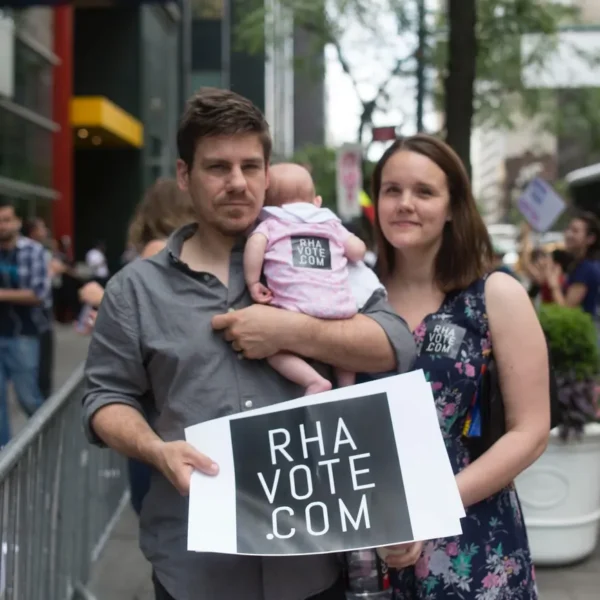
Emily Waldorf’s pregnancy was life-threatening, and no one in Arkansas, not even the Governor, would help her
Synopsis
Emily’s water broke at 17 weeks, and she needed an abortion. Instead, a hospital kept her in limbo for five days, telling her there was nothing they could do because of Arkansas’ abortion ban. As Emily grew sicker, her sister, Elizabeth, called Governor Sarah Huckabee Sanders to plead for help. Rather than intervening to save Emily’s life, the Governor’s office suggested she get a lawyer. Emily—along with three other women and a doctor—is now suing the state of Arkansas in the first case filed by Amplify Legal, the litigation arm of Abortion in America.
The sisters spoke with Abortion in America about the choices their family had to make, and the rush to get Emily safely to Kansas before it was too late. Their story has been edited for length and clarity.
Emily: I get to the hospital and I expect the OBs to take care of me. And their answer was, “Our hands are tied behind our back.” And one of the doctors told me, “You’ll get bacteremia in your bloodstream. You will go to the ICU. You’ll be put on a ventilator.”
Elizabeth: Right. And it’s like—Why? Why are we gonna let her get that sick before we do something?
I can remember, while we were still in Arkansas, at one point you looked at me and said, “Are they gonna let me die?”
I remember when you asked me that, the big sister in me wanted to kick in and just be like, “Not if I can do something about it.”
I didn’t know what to say to you. I just said, “Of course not. Of course you’re not going to die.” But we needed her heart to not be beating to be able to provide you with the care to save your life.
Having gone through all that, and then having your blood drawn every day just to see if you were septic yet, it was scary and frustrating.
After five days of that, I was just like, There’s got to be another way. And you said, “Would you drive me to Kansas to a hospital to receive better care?”
Emily: My husband didn’t want to do it by himself. We didn’t want to be alone.
Elizabeth: I just remember thinking, it didn’t matter what you had asked me. You said, “I need you to help me.” And I said, “Yes, whatever you need. Of course I’m going to do that.”
I was given the name and number for a Medevac helicopter, and they said that they would have blood on board. They were willing to do it, and they can do it within like the next 45 minutes. I remember your husband looking at me and mouthing, “How much?” It was going to be over $25,000. He was just like, “We can’t just write a check for that.” And I remember telling him, “Don’t worry about it. We’ll figure that part out.”
Luckily, before the Medevac unit got there, your attorney called and said that she had worked a miracle and that you were going to be able to be transported via ambulance to Kansas. You were at a point that you were just excited to hear, Yes, we can transport you. That was your decision.
The big sister in me wanted to kick in and just be like, ‘Not if I can do something about it.’
Emily: I remember telling you to relax, that I’m gonna be okay, even though I wasn’t sure.
Elizabeth: None of us were sure.
Emily: I just wanted to get out of there. I needed to go somewhere where doctors were actually going to take care of me.
Elizabeth: The plan was that we were going to drive through the middle of the night. Your husband got in the car with me, and we followed the ambulance up to the hospital in Kansas. We were driving through pitch-black darkness with fields on both sides of the interstate.
And I thought, My God, if she has the baby now and she hemorrhages, how soon could a Medevac unit land in this field? Could they land in the field? Would it be quick enough?
I felt like I was constantly trying to manage my hypervigilance. Anytime the ambulance’s brake lights came on, my heart would drop. I thought, Are we pulling over? Is it happening? Is it happening? It always felt like it was about to happen.
There was really no way other than to push through it.
I needed to go somewhere where doctors were actually going to take care of me.
I remember being so relieved when we pulled up and saw the lights at the hospital. I thought, She made it.
When we were rounding the corner to pull into the emergency room bay, you leaned up off the gurney and hugged the paramedic sitting in the back with you. Your husband and I both looked at each other, like, Emily’s not very affectionate. Why is she hugging this woman?
Emily: Didn’t you think she looked like Mom?
Elizabeth: She did. She looked so much like Mom. So much like Mom. We asked you why you hugged her, and you said it was because she had sat back there the whole ride and crocheted you a little bitty baby blanket. Someone who didn’t know you, didn’t know your story or why they were transporting you to Kansas, was the first person to show you any humanity.
We had been in the hospital for almost six days, and not once did anyone show you sympathy. Kindness. Humanity. That was the first time I felt like we were in the right place.
Emily: I think people don’t realize what kind of health care abortion is. Arkansas women are in danger. Anytime a friend tells me they’re pregnant, I’m worried for them. My story happened a year ago—how many more women has this happened to that we don’t know about? How many more women are going to die in our state because of these abortion bans? That scares me.
This can happen to anyone. You shouldn’t have to travel outside of your home state to receive health care. But that’s the case that we’re in in Arkansas.
If this happened to you or someone you love, contact Abortion in America or reach out directly to our team at Amplify Legal.
Explore more stories from Abortion in america
They Didn’t Want to Have C-Sections. A Judge Would Decide How They Gave Birth.
Women who pursued Idaho abortion lawsuit accuse anti-abortion website of libel